Who’s updated recommendations: a renewed call to strengthen global and local commitments toward malaria elimination
To the editor, On April 24, 2025, the World Health Organization (WHO) issued an urgent call to reinvigorate global action to end malaria, releasing updated guidelines that reflect both progress and persisting challenges in combating this deadly disease. [1] This renewed guidance arrives at a critical juncture: global malaria cases have plateaued, progress is faltering, and health systems in endemic regions face increasing strain from drug resistance, climate change, and funding shortfalls.
 Karishma
Training &development initiative for entrepreneurship promotion by tgb -resti : an analysis from state level bankers committee database
Rural Self Employment Training Institutes (RSETIs) functions as a structural framework for skill development & entrepreneurship development training laid down by Ministry of Rural Development, Government of India in the year 2009. The concept of RSETI is bagged from the RUDSETIs (Rural Development & Self Employment Training Institutes), the brain child of Dr. D. Veerendra Heggade. RSETIs have 65 approved courses as per National Skill Qualification Framework (NSQF) under which they offer different types of Entrepreneurship Development Programme (EDP). All the programmes are short term residential training with 2 (two) years hand holding support. State Level Bankers Committee data revealed that through the RSETI training, huge number of unemployed youths started their own enterprise with or without bank finance and also getting the scopes of Self-employment. This particular study took a humble effort to publicize the role of TGB-RSETI in Tripura in respect to unemployment reduction through entrepreneurship development. The entire study is based on secondary data (2009-10 to 2022-23) retrieved from SBLC, Tripura website data.
 Md. abdur rahman choudhury
Strategic international business management - change management of sarhs
This paper aims to study the restructuring and change management of SARHS, which in turn will be accompanied by some complex, difficulties and discussions that may include personnel emotion, which must be taken into account. We will guide SARHS managers by conducting a comprehensive study of majority factors that will affect the success of the process, considering and covering all views. Which will result in the dismissal of some employees and the closure of their jobs permanently in the new job structure. The study will include many theories, models and justified recommendations to be followed to ensure a successful and safe restructuring and management change free from unresolved impediments and difficulties that could lead to a setback. Finally, restructuring is not a result but the beginning of a new process
 Mohamed sorogy
Dr.ismath shameem
Background: Unexplained infertility is a frustrating diagnosis both for the patient and the clinician, with a prevalence of 16%-37%. It commonly refers to a ‘diagnosis’ made when tubal, ovulatory and husband factors are ruled out. A couple is usually referred for evaluation after 1 year of unsuccessful trials of conception with unprotected intercourse in the fertile phase of the menstrual cycle. Unani formulation comprises of baikh asgand (Withania somnifera Dunal), baikh piyabansa (Barleria prionitis Linn), gule dhawa (Anogeissus latifolia) and gule nilofar (Nymphaea alba Linn) were used for the treatment of uqr, possessing the properties of muqawwi rahim, moaene hamal, moallide mani, etc. Case presentation: A married couple (22 years female partner & 26 years male partner) presented to NIUM Hospital OPD, with chief complaint of failure to conceive since 5 years. The couple report a high degree of stress related to their lack of success. Investigations were carried to check for tubal patency, ovulatory function and semen analysis. Diagnosis of unexplained infertility was made after thorough evaluation of the case. The powder of above mentioned formulation was given 6g twice a day orally with milk from 5th day of cycle for 5 days. Patient got conceived after taking treatment for two consecutive cycles. Discussion: Here we report evidence based management with Unani medicine to help combat the significant physical, psychosocial and economic toll on couples. Keywords: Unexplained infertility; Primary infertility; Uqr; Muqawwi rahim; Moaene hamal; Moallide mani; Unani medicin
Physico-chemical analysis of rhizospheric soil of maize (zea mays l.) and its effects on maize disease incidence (in vivo) in karnataka
PHYSICO-CHEMICAL ANALYSIS OF RHIZOSPHERIC SOIL OF MAIZE (Zea mays L.) AND ITS EFFECTS ON MAIZE DISEASE INCIDENCE (IN VIVO) IN KARNATAKA
 Veerabhadraswamy al
The influence of online distance learning and digital skills on digital literacy among university students post covid-19
Online distance learning policies were formulated and implemented among some Malaysian universities long ago, but their value emerged since COVID- 19. Emanating from the diffusion of innovation theory, this study examined the perception of higher education students on the influence and relationship between six independent variables (compatibility, observability, relative advantage, complexity, trialability, and digital skills) and one dependent variable (digital literacy). A total of 524 respondents were sampled, comprising students from six public and private Malaysian universities. The findings from the correlation analysis show a significant positive relationship between the six independent variables and the dependent variable. Meanwhile, in the regression analysis, three of the independent variables (observability, trialability, and digital skill) have a significant and positive effect on digital literacy. This study placed the diffusion of innovation in a specific context that supports designing online distance learning and digital literacy policies
 Mohammed fadel arandas
Firearms in mughal india
During the 16th century, firearms played a transformative role in Indian warfare, considerably enhancing the effectiveness of the Mughal army. The introduction of muskets and artillery by Babur in 1526 revolutionized military strategies, giving the Mughals a decisive advantage in battles and sieges. The Mughal army’s structure, particularly under Akbar’s Mansabdari system, centralized control and ensured a loyal, efficient military force. This technological and organizational superiority enabled the Mughals to consolidate power over diverse regions through a combination of military might and diplomacy. By the 17th century, there was a significant change in rebellions as firearms started being used by peasants. This shift in weaponry fundamentally altered the nature of these uprisings, empowering the peasantry in new ways to resist authority. Multiethnic regional powers also recognized the importance of firearms, acquiring them from the Mughals or Europeans, and employing them effectively in battles. In the mid-18th century, the Marathas and later the Mysore Sultanate took a notable step by establishing arms factories and engaging European experts to produce advanced firearms. This marked a departure from the past, where regional powers typically relied on the Mughals or European companies for firearm procurement. This shift toward domestic arms production signaled a move toward greater self-sufficiency and the development of advanced firepower. By the 18th century, the Mughal Empire was in decline, and multiethnic regional powers and European colonial forces, equipped with advanced firearms, challenged and eventually overshadowed Mughal dominance.
 Bidyut patar
Nutritional value, ethnomedicine, phytochemistry and pharmacology of vigna radiata (l.) r. wilczek
Vigna radiata (L.) R. Wilczek, commonly known as Mung bean, is one of the most important pulse crops grown from tropical to sub-tropical areas worldwide. Mung bean is reported to help prevent the loss of nails and hair, reduce the risk of hypercholesterolemia and coronary heart disease, and decrease the absorption of toxic substances. Flavonoids and phenols are reported from this plant. Antioxidant, anti-diabetic and hypocholesterolemic activities are also shown by Vigna radiata
 Dr. salman ahmed
A comparative evaluation of furosemide tablets marketed in libya
Furosemide is a widely potent diuretic drug used in the management of edema and hypertension. Various brands of furosemide are available in the Libyan market and should be subjected to different quality control tests to assess their pharmaceutical equivalence. This study aimed to assess and compare the quality and the pharmaceutical equivalence of some generic brands of furosemide 40 mg tablets marketed in Libya. The pharmaceutical quality of four brands of furosemide tablets was investigated using official and unofficial compendia standards including uniformity of weight, friability, thickness, hardness, drug content and dissolution rate. The results obtained showed acceptable external features as well as the thickness, diameter and uniformity of weight for all the furosemide tablets. The tested brands complied with the official specifications of friability, hardness and drug content. In conclusion, all four brands can be considered as bioequivalence and thus can be pharmaceutically substituted in clinical practice.
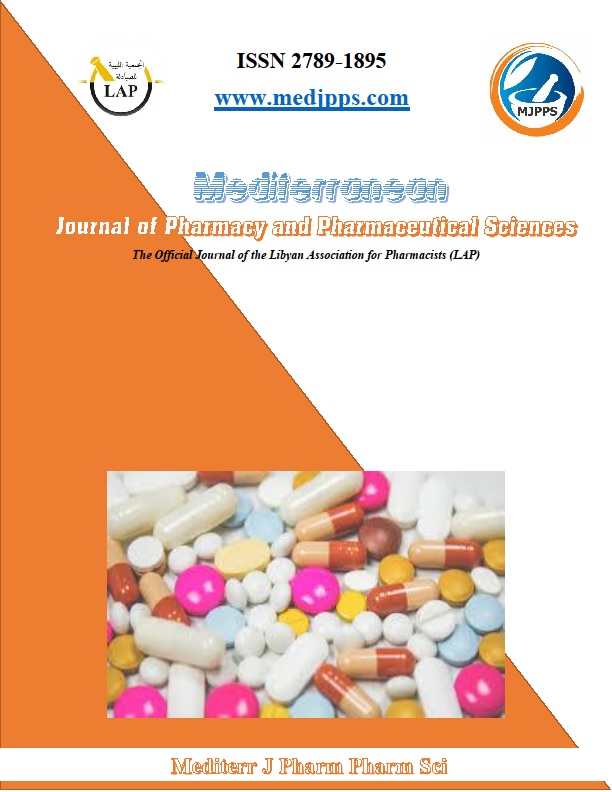 Mediterranean journal of pharmacy and pharmaceutical sciences
Convergent validity assessment in pls-sem: a loadings-driven approach
Assessment of convergent validity of latent variables is one of the steps in conducting structural equation modeling via partial least squares (PLS-SEM). In this paper, we illustrate such an assessment using a loadings-driven approach. The analysis employs WarpPLS, a leading PLSSEM software tool.
 Johnny amora
De la rhétorique du politiquement correct dans le discours présidentiel algerien: éléments d’analyse discursive
Le discours du nouveau Président algérien, Monsieur Abdelmadjid Tebboune, se caractérise par une rhétorique différente de celle de ses prédécesseurs. Notre entreprise, dans le présent article, vise à rendre compte de cette spécificité discursive en interrogeant trois expressions ponctuant souvent son discours. Notre analyse se propose d’examiner des segments de discours collationnés à partir des différents entretiens périodiques accordés aux médias nationaux et internationaux ainsi que des allocutions du président lors des travaux réunissant le gouvernement et les walis. En guise de conclusion, nous déterminerons les motivations du choix de ces formules dans le discours présidentiel.
Systematic review: determinants influencing medications adherence of type 2 diabetes patients in indonesia
Compliance with pharmacological therapy is the primary key to treating diabetes, but it has not received full attention from clinicians. Several systematic reviews of compliance factors have been conducted in several regions of the country. However, it does not feature studies from Indonesia. This study aims to systematically review the factors that can influence adherence to diabetes mellitus (DM) medication in Indonesia. A systematic literature review was conducted by searching the National (Garuda and Sinta) and International (PubMed and Science Direct) journal databases. Research that met the inclusion criteria was published from January 2011 to December 2020. The quality of the study was assessed using the SQAT guidelines. The research reporting method uses the PRISMA guidelines. Compliance factors are classified based on the domain of compliance factors, according to the World Health Organization (WHO). A total of 370 scientific research articles from the Garuda database (n=36); Science Direct (n = 108); PubMed (n = 18); Sinta (n= 208). Three hundred forty-one research articles were excluded, 29 full-text screening articles, and 16 research articles met the inclusion criteria for analysis. Factors that influence adherence to taking diabetes medication are social and economic (income, education level, and occupation), factors of personnel and health systems (health workers), factors of patient therapy (amount of diabetes medication, frequency of taking medication, and drug products), factors patient's disease (blood sugar levels, disease duration), patient factors (gender, emotional factors, social support, level of knowledge, and treatment satisfaction), and disease management factors (pharmacy counseling and education). Factors that influence adherence to taking DM medication in Indonesia are very diverse and are multi-factor. These factors can serve as relevant intervention targets. Clinicians must consider adjusting the frequency of taking medication and providing social support to DM patients.
 Much ilham novalisa aji wibowo
Newspaper advertising for public relations practitioners during the malaya era 1957-1963
The very first recruitment for a public relations practitioner in Malaysia was encountered in 1948 and was advertised by the federal government of the British Colony in Malaya. This paper examines the subsequent advertisements after Malaya sought independence from the British colonial government. A total of eleven recruitment advertisements were found before the formation of Malaysia on the 16th September 1963. This paper outlines the advertisers, the titles of positions, as well as their qualifications and duties. The results show that the job requirement mainly came from the federal and local governments. Generally, the duties were related to information services and some specific responsibilities.
Signage and information and communication technology (ict) facilities as correlate to utilisation of information resources in federal universities’ libraries in south-south zone of nigeria
This study was aimed at investigating the extent to which signage and ICT facilities correlate to the utilisation of information resources in federal university libraries in South-South zone of Nigeria. The correlational research design was adopted for the study. Three research questions were answered while three hypotheses were tested. The population of the study comprised 32,190 registered library users for the 2017/2018 academic session and 776 library staff from six federal university libraries in south-south zones of Nigeria. The sample size for the study was 3,219 registered library users and 310 library staff representing 10% and 40% of the population respectively. A two-stage sampling technique of stratified and simple sampling techniques was used to select the sample size. Two Sets of instruments titled; “Signage and Information and Communication Technology Facilities Questionnaire (SICTFQ)” for the students and “Utilization of Information Resources Questionnaire (UIRQ)”were used for data collection. Face and content validity was ensured by three experts. The two instruments yielded reliability coefficients of 0.81 and 0.87 respectively with the use of Cronbach Alpha. Mean was used in answering research questions while Regression was used in testing the null hypotheses at 0.05 alpha level. It was found that to a great extent signage relates to the utilisation of information resources while information and communication technology facilities is the vice versa. Based on the findings, it was concluded that jointly, signage and ICT facilities are significant correlate to the utilisation of information resources in federal university libraries in South–South zone of Nigeria. It was therefore recommended among others that library management should improve on the provision of signage by ensuring that well-designed signage suitable for the 21st century is placed at strategic location to guide library users on the utilisation of information resources in federal universities libraries in South-South zone of Nigeria.
 Fxintegrity publishing
Association between oral health literacy, gingival health and oral hygiene among dental patients
Objective: To determine the association between oral health literacy, oral hygiene and gingival health status. Methods: This cross-sectional study was conducted among patients attending University of Benin Teaching Hospital, Benin City. Data were collected through interviewer-administered questionnaires. Index used in this study for estimating oral health literacy levels was Rapid Estimate of Adult Literacy in Dentistry- 30 (REALD-30). The participant’s oral hygiene status was assessed using the Simplified Oral Hygiene Index while gingival health was assessed using the Gingival Index. Results: Two hundred and eight participants with 130 (62.5%) males and 78 (37.5%) females formed the population of the study and their mean age was 28.32 ± 10.5 years. The prevalence of low oral health literacy was 86 (41.3%). The oral hygiene status of most of the participants 100 (48.1) was fair. The prevalence of gingivitis was 58.2%. Oral health literacy had significant statistical negative correlation with age, oral hygiene and gingival health status. Oral health literacy consistently emerged as a predictor of oral hygiene and gingival health status. Conclusion: Majority of the participants with low oral health literacy had fair/poor oral hygiene status (p = 0.000, OR= 17.870, 95% CI = 7.320-43.627) and gingivitis (p = 0.000, OR= 7.054, 95% CI = 3.514-14.164).
 Hope inegbenosun
University students’ fear of success from the perspective of positive psychology
The aim of this study was to examine university students’ fear of success from the perspective of positive psychology. Two objectives were addressed: first, analyzing the relation between fear of success, optimism, self-esteem, self-efficacy, and search for meaning in life; second, exploring the variance of the fear of success, taking into account the affective dimension of the self (self-esteem) and search for meaning in life. The results confirmed that fear of success was positively related to search for meaning, and negatively to optimism, self-esteem, and self-efficacy. The variance of the fear of success was explained by the self-esteem and search for meaning in life. Implications for school psychologists were discussed.
Intersection of caste and gender based subjugation
One of the unique features of Indian society is prevalence of caste system which was originated thousands of years back to demarcate the people engaged in different occupation or jobs. Initially it was not much rigid but gradually people belonging to upper castes for their own selfish means to maintain their monopoly made this arrangement hereditary and started treating people of lower castes disgracefully. For preservation of this system, people started controlling their women to prevent inter-caste marriages and the concept of endogamy came up. This robbed away many types of freedom from women. For women belonging to lower castes, this situation is worse as they are doubly subjugated on the basis on caste as well as gender. Men belonging to their own caste treat them as secondary beings. This paper throws light on this intersection. How intersection of these two kinds of inequalities place them at the lowest position in Indian society. Dr. B.R. Ambedkar rises as their leader who all his life worked for empowerment of downtrodden section of society. He argues that education is the primary tool for evading these differences among people. He further emphasizes to adopt the concept of exogamy to break the backbone of Indian caste system and to immediately leave a religion or culture which legitimizes such system of inequality among people of the same land.
Application of artificial neural networks in predicting sub-base cbr values
Establishing a realistic working profile of soil properties has been, and is still, one of the most challenging problems facing Geo-technical engineers, especially for CBR results. In the present study a neural-network approach is used to tackle this problem. Source data of a series of California Bearing Ratio Tests (CBR) performed at the Laboratory and Geo-technical Experimental Site. This will be useful for training and testing an artificial neural network. The developed neural network will be showing the prediction of CBR values of the site studied. Data are then generated for constructing the profiles of the CBR values using the trained neural network. This study might be useful for the future as this process will reduce the work on procedure and graphical calculations.
Simulations of solving a single-player memory card game with several implementations of a human-like thinking computer algorithm
The memory card game is a game that probably everyone played in childhood. The game consists of n pairs of playing cards, whereas each card of a pair is identical. At the beginning of the game, the deck of cards is shuffled and laid face down. In every move of the game, the player flips over two cards. If the cards match, the pair of cards is removed from the game; otherwise, the cards are flipped back over. The game ends when all pairs of cards have been found. The game could be played by one, two, or more players. First, this paper shows an optimal algorithm for solving a single-player memory card game. In the algorithm, we defined four steps where the user needed to remember the earlier shown pairs of cards, which cards were already shown, and the locations of the revealed cards. We marked the memories related to these steps as M1, M2, M3, and M4. Next, we made some simulations as we changed the M1, M2, M3, and M4 memories from no user memory (where the player does not remember the cards or pairs of cards at all) to a perfect user memory (where the player remembers every earlier shown card or pair of cards). With every memory setting, we simulated 1000 gameplays. We recorded how many cards or pairs of cards the player would need to remember and how many moves were required to finish the game. Finally, we evaluated the recorded data, illustrated the results on graphs, and drew some conclusions.
 Ladislav végh
Business strategy - automotive business case - tesla
Because of globalisation's intense change and competition pressure, businesses are driving from the company's dimension of individual management to collaborative cooperation approaches aided by the anticipated business strategy. A business strategy is a decision or action of a business or organisation to attract customers and achieve the organisation's objective. These strategies are the master plan for securing a competitive position of the firm market area of the competitors. Through business strategies, organisations will carry their business operations and fulfill the customers' desires and demands. Multination organisations and firms establishing subsidiaries and business entities in international markets or foreign countries must adopt different strategies during the integration process. The macro-economic and intercultural factors are the epicenter for change and must be considered in complex ventures. In the modern competitive market, multinational firms must collaborate and communicate with the partners, suppliers and customers through a complicated and temporary product supply chain. Business strategies involve complex processes requiring information on the diverse sources that need simultaneous changes by the managers of entrepreneurs. I this report, I choose Tesla Inc or Tesla Motors to explore the key strategies they have anticipated to inherit the global motor vehicle sector within the past few decades. The organisation was founded in 2003 by a group of various engineers. Tesla Motors deal in the automotive industry and has transformed its services to the global society.
 Zamzam abdelazim
Most Popular Category
- Pharmacy (270)
- Education and social science (224)
- Pharmacology (223)
- Pharmacognosy (178)
- Business management (147)
- Pharmacology and toxicology (134)
- Education and training (131)
- Pharmaceutical sciences (130)
- Medicine (129)
- Research (123)
- Health Science (100)
- Biological Sciences (99)
- Management (98)
- Computer Science (94)
- Public health (91)
- Computer Science Applications (87)
- Human resource management (83)
- Engineering (80)
- Accounting and finance (73)
- Information technology (69)