Human resource management - mind map on traditional functions of hrm
Human resource management refers to the process of employing people, training them, compensating, and developing policies and strategies to keep them (Storey, 2016). Personnel management is an administrative specialisation that focuses on hiring and developing employees to become valuable to the organisation (Bondarouk, Trullen, and Valverde, 2016). Management of personnel can be characterised as a satisfied workforce being achieved, used, and maintained (Sheehan, Garavan & Carbery, 2014). It constitutes an essential aspect of the management of employees in the organisation and their connection. According to Schroeder (2012, p.4), personnel management is achieved to help organisational, individual, and social goals, as the planning, organisation, offsetting, and maintaining of people. Vargas et al. (2018, p. 3052) add that personnel management is the element that primarily deals with human organisational resources. Management of personnel covers job, development, and compensation functions. In consultation with other departments, the personnel management performs these functions principally (Vargas et al., 2018, p. 3053)
 Zamzam abdelazim
Numerical simulation of electroosmotic flow in a rectangular microchannel with use of magnetic and electric fields
Pumping fluid is one of the crucial parts of any microfluidic system. Using electric and magnetic fields as a substitute for moving parts can have many advantages. In this study hydrodynamic and heat transfer characteristics of electroosmotic flow under influence of lateral electric and transverse magnetic field, are studied numerically. Results indicate that the dimensionless parameters such as Hartmann number, intensity of the lateral electric field, pressure gradient parameter and aspect ratio have an important role in controlling flow. It can be implied that the enhancement of pressure gradient leads to the decrease of critical Hartmann number, and this dependency can be reduced from 44% to 7% for S=0.5 to S=50 in two pressure gradients of Ω=1 and Ω=20. In addition, the reduction of aspect ratio of microchannel section leads to the increment of critical Hartmann number in a specified lateral electric field. At the end, thermal analysis is being done by consideration of the effects of magnetic and electric fields on the Nusselt number.
 Hossein seyedzadeh
Current global scenario of trachoma with special emphasis on the ‘safe’ strategy: a review
Trachoma is a Neglected Tropical Disease (NTD) and one of the most common ocular contagious diseases, caused by different serovers such as A, B, Ba ,C of bacterium Chlamydia trachomatis that occurs recurrently. Most infants are adversely affected from chronic keratoconjunctivitis, leading to blindness in later life. Epidemiological studies in 2023 revealed that approximately 115.7 million people were at risk of trachoma, but presently it has been declined to almost 103.2 million. Basically this disease is predominant in least developed or developing nations with high poverty. Preventive measures being implemented by the World Health Organization (WHO) , popularly known as ‘SAFE’ strategy: S for surgery, A for antibiotic dissemination, F for facial cleanliness, and E for environmental improvements. Now-a-days it is effectively and extensively applied; that’s why number of active patients are reduced drastically, but trachoma-free world creation should be the principal and researches will make it possible.
Atlas of shear zone structures in meso scale
The Atlas of Shear Zone Structures in Meso-Scale illustrates the morphological characteristics of shear zones within the Himalayas that have been gathered by the author’s intensive field observations over the last decade. The book deals with various shear zone-related structures, produced in brittle and/or ductile regimes. The shear sense indicators and associated microstructures are also described.
 Rajkumar ghosh
Laboratory findings of libyan patients with covid-19 in intensive care unit
The 2019 coronavirus disease (COVID-19) was declared by the World Health Organization as a pandemic on 11th March, 2020 which spread rapidly all over the world. COVID-19 disease has different clinical presentations, ranging from asymptomatic to severe symptoms. Laboratory findings are important in determining which therapeutic strategies to seek and to identify severe cases initially. In this study, we compared the results of C-reactive protein, D-dimer, blood electrolytes and mean corpuscular hemoglobin concentration between survivors and non-survivors of 22 Libyan patients with COVID-19 present in the intensive care unit at Maitika Isolation Center (Tripoli, Libya) in the period of January to June 2021. We could not detect any significant difference in C-reactive protein between survivors and non-survivors but a significant difference in D-dimer level was observed. Non-survivor COVID-19 patients have a higher level of D-dimer. Moreover, a statistical significant difference in chloride and sodium levels but not in potassium level were detected. A marked lower of mean corpuscular hemoglobin in non-survivor than survivor COVID-19 patients was shown. Thus, these parameters could act as biomarkers for COVID-19 patients.
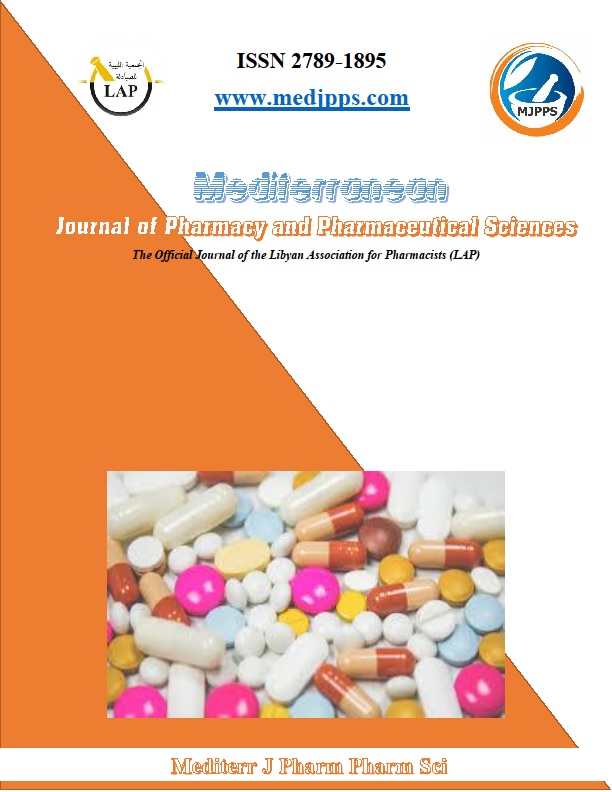 Mediterranean journal of pharmacy and pharmaceutical sciences
Pharmaceutical situation of the pharmacological treatment of hospitalized patients with covid-19 in libya
By January 2020, severe acute respiratory syndrome coronavirus-2 has spread internationally to a pandemic that mainly targets the respiratory system. The relevant infectious disease has been identified as coronavirus disease-2019 (COVID-19) by World Health Organization and declared as a global pandemic. In Libya, National Center for Disease Control reported the first case of coronavirus disease-2019 on 24th March, 2020. The authorities decided to close borders and activate designated treatment centers to deal with COVID-19 cases and contain the outbreak of SARS-COV-2. This study aimed to assess and evaluate the pharmaceutical situation of medications used in pharmacological management of hospitalized COVID-19 patients in Tripoli, Libya. Three WHO availability indicators were selected to be studied and reported. A comprehensive list of medicines used in the management of hospitalized COVID-19 patients was constructed after reviewing and comparing seven national and international pharmacological management protocols and guidelines for hospitalized COVID-19 patients. This comparison revealed that nearly 50 medications are intended for use in COVID-19 inpatient pharmacological management. They all agreed about the use of three medications, representing one from each main class. This list was used to cross check their availability at the chosen designated COVID-19 treatment center. This study proved that local treatment center’s protocol is more in line with international guidelines than the national treatment guideline. The later was issued on March 2020. The Libyan National Essential Medicines’ List contained 25 out of 50 medications of the comprehensive list based on the last update in April 2019. This study recommends that national treatment guidelines and National Essential Medicines’ list require updating. Not all medications used in COVID-19 inpatient management were available in local treatment centers, although, the Emergency Management Department of Ministry of Health in Libya is responsible for the supply of the required medical supplies and medications to the COVID-19 treatment centers.
Mediterranean journal of pharmacy and pharmaceutical sciences
. therapeutic potential of marine peptides in glioblastoma: mechanistic insights
Glioblastoma multiforme (GBM) is the most common primary malignant brain tumor in humans. It is characterized by excessive cell growth, accelerated intrusion of normal brain tissue, and a poor prognosis. The current standard of treatment, including surgical removal, radiation therapy, and chemotherapy, is largely ineffective, with high mortality and recurrence rates. As a result, traditional approaches have evolved to include new alternative remedies, such as natural compounds. Aquatic species provide a rich supply of possible drugs. The physiological effects of marine peptides in glioblastoma are mediated by a range of pathways, including apoptosis, microtubule balance disturbances, suppression of angiogenesis, cell migration/invasion, and cell viability; autophagy and metabolic enzymes downregulation. Herein, we address the efficacy of marine peptides as putative safe therapeutic agents for glioblastoma coupled with detailed molecular mechanisms.
 Dr. salman ahmed
Social factors influencing mental health: insights, preventive strategies, and policy recommendations
Introduction: Mental health disparities are deeply entrenched within the fabric of societal inequalities, shaped by structural factors that perpetuate intergenerational cycles of disadvantage. Addressing these disparities is crucial for promoting social justice and improving public health outcomes. Aim: This paper aims to synthesize high-quality evidence to elucidate the causal relationships between social determinants and mental health outcomes. It prioritizes pervasive social determinants that influence major mental disorders across the life course and outlines preventive strategies to mitigate these effects. Methodology: A comprehensive literature review was conducted, focusing on publications from the Global North from 2014 to 2024, to explore the influence of social determinants on mental health. Keywords such as "social determinants," "mental health outcomes," "preventive strategies," and "vulnerable populations" guided the search across databases like PubMed and Google Scholar. Results: The review highlights significant associations between mental health and social determinants such as socioeconomic status, racial and ethnic marginalization, and exposure to adverse environments. It underscores the heightened vulnerability of marginalized groups, including refugees, LGBTQ+ individuals, and those living in poverty. The paper introduces a preventive framework to guide primary prevention efforts and reviews both primary and secondary strategies to improve mental health equity. Conclusion: Strategic interventions aimed at the root social causes of mental health disparities can substantially enhance public mental health. This paper provides seven strategic recommendations focused on social justice, offering a roadmap for researchers, policymakers, and public health professionals to address these pressing issues.
 Prof.k.c yadav
“the person with maximum knowledge will win the race”: conceptualizing knowledge in microbusinesses
The concept of knowledge and the process of knowledge sharing in ethnic minority microbusinesses remain neglected in contemporary debates even if their role for economic development is recognized. Drawing on a culturalist view, we explore how knowledge is defined and shared in a local niche market. Thematic analysis of semistructured qualitative interviews with 32 owner managers and 11 employee-managers reveals that, contrary to studies on larger firms, local knowledge creation and sharing narrowly based on ethnic strengths are valuable sources of competitive advantage. Our study has implications for researchers, policymakers, and practitioners in exploring, supporting, and integrating ethnic minority microbusinesses.
A review on the potential of remdesivir against sars cov2
Covid 19, the pandemic originated in the Chinese city of Wuhan, had the entire world conquered. The structure and transmission of the causative organism, Coronavirus is well studied. Remdesivir, the product of Gilead pharmaceuticals, was effective against many viral infections, including Ebola and SARS. It comes under the category of nucleoside prodrug and has given promising results in the early trials against SARS COV 19. In depth, research is taking place at a rapid pace, so that Remdesivir will be available to the therapeutic community as an effective remedy for the pandemic caused by SARS COV2. If this meets success, the darkest era in the modern history of mankind may become a memory in the near future.
 Vinod b
A study on psychosomatic problems related to the problematic internet use among adolescents at selected schools of aspur block, dungarpur
Adolescents’ scholastic and social life has become increasingly reliant on the internet and mobile technology in recent years. Problematic Internet Use (PIU) is a growing problem in Indian adolescents. However, in many cases, this use has become obsessive, causing them to neglect other elements of their lives. Adolescents account for over 35% of internet users in India. The purpose of this study was to evaluate the psychosomatic problems related to internet overuse among school going adolescent students. This cross-sectional survey was conducted among 348 students in selected schools of Aspur block in Dungarpur-district, Rajasthan, India in the month of February 2016. Problematic internet use (PIU) was assessed by Young’s twenty question internet addiction test. The Depression, Anxiety, Stress Scale (DASS-42) and self structured questionnaire check list was used to measure psychosomatic problems among adolescents. Approximately 5.17% adolescents showed Problematic internet use (PIU). Adolescents with PIU were associated with age between 14-16 year, males,10th class of study, using internet since more than 3 years, being at home, mobile as a source of internet use, purpose of internet use with online gaming. Compared with normal internet users, there were significant correlation between Problematic Internet Use and Somatic Complaints r=0.3660, p<0.05, Depression r=0.3982, p<0.05. Anxiety r=0.2512, p<0.05 and Stress r=0.2886, p<0.05. Problematic internet use (PIU) is an increasing problem among teenagers and it has been linked to psychosomatic issues. Timely Effective measures are needed to prevent the spread of this problem
 Dr k c yadav
Cytotoxicity study of aqueous extract of asam gelugur (garcinia cambogia) against vero cell line: implications for nutraceutical safety
Garcinia cambogia, commonly known as Asam Gelugur, has entrenched itself as a traditional herbal medicine, renowned for its applications in treating obesity and its integration into global nutraceutical formulations. The bioactive compounds within, particularly hydroxy citric acid, mediate various effects. This study aims to assess the in vitro cytotoxicity of Taxol, a cytotoxic drug used as a control, and the aqueous extract from Garcinia cambogia against the Vero cell line - a kidney-like cell. Cytotoxicity was evaluated using the 3-(4,5-dimetyl-2-2thiazolyl)-2, 5-diphenyl-2H-tetrazolium bromide (MTT) assay. The assay relies on mitochondrial succinate dehydrogenase's potential to reduce MTT, providing a colorimetric indication of cell viability. The results revealed an IC50 value exceeding 500 µg/mL for the aqueous extract from Garcinia cambogia significantly higher than Taxol's 0.0581 µg/mL. This higher IC50 value implies lower toxicity, positioning the Garcinia cambogia extract as a safe component in nutraceuticals and herbal supplements. The aqueous extract of Garcinia cambogia demonstrates low cytotoxicity, reinforcing its safety profile for use in nutraceuticals, which contributes valuable insights into the safety considerations of incorporating Garcinia cambogia into herbal supplements.
Mediterranean journal of pharmacy and pharmaceutical sciences
Finance for decision makers
In their different ownership structures, business enterprises pursue different strategies towards accomplishing their owners’ needs and interests. At the heart of these accomplishments is the generation of sufficient financial returns to cover obligations as they become due and residual incomes for the owners. It is doubtless that without a grip of financial stability, the survivability of for-profit organizations becomes bleak. Financial management plays and instrumental role in this case. The generation of sufficient information for decision making for the business and investors alike is integrally critical in shaping the progression of the business enterprise. While businesses provide financial statements according to prevailing laws and accounting standards to the public for their consumption in decision making, they are further needed to be accountable to them regarding their performance and investors’ engagements, especially considering that investors are foundational sources of capital for organizational operations.
Standardization of artificial diet for the mass rearing of helicoverpa armigera
Experiment was carried out to standardize the artificial diet for mass rearing of Helicoverpa armigera (Hübner) under laboratory conditions. The average length and breadth of egg was 0.51±0.06 mm, 0.46±0.37 mm and 0.52±0.03 mm, 0.48±0.62 on artificial and natural diet. The average length and breadth of first, second, third, fourth and fifth instar larvae was 1.40±0.09 mm, 0.46±0.02 mm and 1.42±0.01 mm, 0.47±0.16 mm and 4.03±0.22 mm, 0.66±0.07 mm and 4.31±0.01 mm, 0.89±0.25 mm and 8.19±0.36 mm, 1.57±0.63 mm, and 10.29±0.72 mm, 1.87±0.91 mm and 18.70±0.44 mm, 2.78±0.040 mm and 20.15±0.03 mm, 3.17±0.55 mm and 26.01±0.19 mm, 4.09±0.39 mm and 27.32±0.027 mm, 5.88±0.69 mm, respectively with the average duration of 2.69±0.32 and 2.54±0.29, 3.77±0.65 and 3.79±0.11, 3.88±0.49 and 3.72±1.23, 5.35±0.55 and 5.72±0.91 and 6.61±0.008, 6.46±1.07 days, respectively on artificial as well as on natural diet. The average length and breadth of adult male and female was 18.01±0.48 mm and 35.09±1.25 mm, 18.51±1.04 mm and 38.11±1.37 mm, 19.00±0.18 mm and 19.10±0.49 mm, 37.75±1.27 mm and 41.23±1.69 mm, respectively. The average pre-oviposition, oviposition and post-oviposition period was 2.52±0.86 and 2.76±0.84 days, 4.93±0.78 and 5.08±0.90 days and 0.65±0.49 and 0.79±0.93 days, respectively. The total life cycle of male and female was 40.50±2.29 and 41.81±1.89 days and 42.59±1.77 and 43.80±1.93 days.
 Dr. babu lal jat
To evaluate effects of combination of topical 5% phenylephrine and 0.8% tropicamide on pulse rate and blood pressure
Background: Dilation of pupil in Ophthalmic OPD is a routine procedure. Whether a sympathomimetic agent like phenylephrine should be used in hypertensive patients is still a question to be answered. This study tries to resolve the issue. Objective: To evaluate cardiovascular effects of combination of topical 5% phenylephrine and 0.8% Tropicamide. Method: Total 150 patients were subjected for this study (male and female) between 30-80 years of age. Combination of 5% phenylephrine and 0.8% tropicamide eye drops was instilled at an interval of 15 minutes thrice in the eyes of each patient. Any change in BP or HR was recorded Result: The data was collected and subjected to appropriate statistical method using R software version 4.2.1. This study has shown no significant increase in Blood Pressure and Heart Rate after instillation of 5% Phenylephrine and 0.8% Tropicamide eye drops except in one case. Conclusion: We conclude that combination of 5% Phenylephrine and 0.8% Tropicamide can be safely used in all patients who come for ocular examination but precautionary measures should be taken in hypertensive patients.
 Dr. ashwani kumar ghai
The impact of implementing a pharmacy triage system on the reduction of patients’ waiting time in the fourth floor outpatient pharmacy at hamad general hospital, qatar
Background and Objectives: The outpatient department (OPD) pharmacy is a section of the hospital pharmacy that helps patients obtain their prescribed medications. However, on-time delivery of medications and patients’ convenient access to the pharmacy are the hallmarks of a well-designed health-care system. Therefore, he aim of this study was to develop a pharmacy triage tool to improve patient flow and reduce waiting time in the fourth-floor pharmacy at Hamad General Hospital (HGH). Methods: This prospective and observational study was conducted on 14,740 patients who attended the OPD pharmacy (HGH, Qatar) between January 15, 2022 and March 15, 2022. This prospective and observational study consisted of three periods: A root cause analysis, a pre-intervention period of 1 month (January 15, 2021–February 14, 2021) and an intervention period of 1 month (15 February–15 March). We developed a pharmacy triage tool to improve patient flow and reduce waiting time by identifying patients who need their medications to be dispensed, as well as classifying patients to get the right patient to the right place and implementing a patient flow system to improve efficiency spends in pharmacy queues. Results: The results of this study showed that the use of the triage system in the pharmacy reduced the average waiting time of patients from 50 min to 15 min. The results were statistically significant at p<0.0001. Conclusion: We concluded that applying the pharmacy triage tool improved quality of services in health-care systems and decreased waiting time in the OPD pharmacy. The pharmacy triage tool is a new approach to enhancing the quality of healthcare and leads to an increase in the efficiency of OPD pharmacies.
 Karishma
Vendors on the streets: their situation and issues (with special reference of lucknow district, uttar pradesh)
Vending on the street is a worldwide fact and the most able to be seen component of the casual economy. Street vending, like other informal sectors, is characterised by low pay, ease of entrance, self-employment, and a huge number of individuals. Millions of individuals make a livelihood selling a variety of products and services on the street in cities and towns all over the globe. Despite the popular assumption that street selling would decline as the economy improves and wealth rises, it is on the rise in many areas. Because of their poor level of education and abilities, street sellers are often individuals who are not capable to get usual employment in the remunerative recognized sector. They attempt to address their financial issues by relying on their own limited financial resources. They are primary sharing route for a wide range of the daily-use goods, such as fruits, vegetables, ready-to-wear clothes, home appliances, stationery, toys, newspapers, magazines and shoes among others. If they be removed from the urban marketplaces, it would create serious problem for vegetable and fruit growers and small-scale businesses that couldn't afford to sell their goods via the formal sector's costly distribution networks. The significance of this industry can not be overstated, particularly given the government's inability to offer employment to India's millions of jobless and underemployed citizens. Even the corporate sector can only absorb a small part of our growing workforce. Overall, employment in the official sector is decreasing, leaving the majority of Indians to fend for themselves. If governments wish to decrease unemployment and poverty in our nation, they should support people in the informal sector to develop and thrive. They play an important part in the economic development and growth of local economy. Municipal authorities see street sellers as nuisances and the encroachers on sidewalks pavements and they are unappreciative of the important services that the street vendors offer to the world's common public. Vendors on the street offer essential services to urban people while surviving on their own business, limited resources, and labour. The state government and municipal authorities have been asked to provide security for street sellers so that they may make a living without fear.
 Dr. amarjeet singh
“in vivo approach: potential diuretic activity of m. charantia linn. on alloxan induced albino wistar rats in diabetes mellitus”.
The screening of perfect diuretics for non-clinical utility in Diabetes mellitus is a relatively novel approach which gain inssight into underlying the pathophysiological processes. This study is aims to evaluate the diuretic effect of a crude aqueous & alcoholic extract of M.charantia Linn. using Albino Wistar Rat model. In this study, the comparative observation of Diuretic activity with standard and extracted compound were shown that the estimated 24‐hour urine contains the Na+ - 3.82 g, 3.82 g, 3.92 g and K+ - 1.35 g, 1.39 g, 1.48 g wt. for Vehicle control, Standard drug, and Extracted compound respectively. Which possess the favoring result means from the spot urine were 10.7±7.0 g/24 h and 3.9±2.1 g/24 h, respectively. Coefficients were 0.035, 0.022, 0.046 at (d±2SD = 7.07 g, 4.42 g and 8.92 g) for sodium chloride and 0.068, 0.031, 0.046 at (d±2SD =4.92 g, 2.31 g, and 3.34 g) for potassium chloride. The Na+ and K+ results can be deduced by conversion (1 g NaCl=0.4 g Na+, 1 g KCl≈0.5 g K+). The present study guide formulation of non clinical trials with statistical study to further measuring the claimed efficacy of M. charantia as a natural remedy for diabetes mellitus.
 Wahul umesh
The impact of turbulence and phytoplankton dynamics on foam formation, seawater viscosity and chlorophyll concentration in the eastern english channel
The space-time dynamics of chlorophyll a concentration and seawater excess viscosity has been investigated in the hydrographically contrasting inshore and offshore water masses of the eastern English Channel. This was done during the phytoplankton spring bloom dominated by Phaeocystis globosa before and after the very large-scale formation of foam induced by an increase in wind-driven turbulence and the related wave breakings. The results suggest that the dynamics of chlorophyll a concentration and seawater excess viscosity are differentially controlled by the formation of foam through the intensity of the spring bloom and wind-generated turbulence.
 Irma kesaulya
Systematic review : determinan faktor yang memengaruhi kepatuhan pengobatan pasien diabetes tipe 2 di indonesia
Kepatuhan terhadap terapi farmakologi merupakan kunci utama pengobatan penyakit diabetes, tetapi belum mendapat perhatian penuh oleh para klinisi. Beberapa systematic review faktor kepatuhan telah dilakukan di beberapa kawasan negara. Namun, tidak menampilkan studi dari Indonesia. Penelitian ini bertujuan untuk meninjau secara sistematis faktor-faktor yang dapat memengaruhi kepatuhan minum obat diabetes melitus (DM) di Indonesia. Systematic literature review dilakukan melalui pencarian pada database jurnal Nasional (Garuda dan Sinta) dan Internasional (PubMed dan Science Direct). Penelitian yang sesuai dengan kriteria inklusi dan dipublikasikan pada Januari 2011 – Desember 2020. Kualitas penelitian dinilai menggunakan panduan SQAT. Metode pelaporan penelitian menggunakan pedoman PRISMA. Faktor kepatuhan diklasifikasikan berdasarkan domain faktor kepatuhan menurut World Health Organization (WHO). Sebanyak 370 artikel ilmiah penelitian dari database Garuda (n=36); Science Direct (n= 108); PubMed (n= 18); Sinta (n= 208). 341 artikel penelitian dieksklusi, 29 artikel skrining full text, dan 16 artikel penelitian memenuhi kriteria inklusi untuk dianalisis. Faktor yang memengaruhi kepatuhan minum obat diabetes adalah faktor sosial dan ekonomi (penghasilan, tingkat pendidikan, dan pekerjaan), faktor tenaga dan sistem kesehatan (tenaga kesehatan), faktor terapi pasien (jumlah obat diabetes, frekuensi minum obat, dan produk obat), faktor penyakit pasien (kadar gula darah, durasi penyakit), faktor pasien (jenis kelamin, faktor emosional, dukungan sosial, tingkat pengetahuan, dan kepuasan pengobatan), dan faktor pengelolaan penyakit (konseling dan edukasi farmasi). Faktor yang memengaruhi kepatuhan minum obat DM di Indonesia sangat beragam, dan multi faktor. Faktor tersebut dapat berfungsi sebagai target intervensi yang relevan. Para klinisi perlu mempertimbangkan penyesuaian frekuensi minum obat dan pemberian dukungan sosial kepada pasien DM.
 Much ilham novalisa aji wibowo
Most Popular Category
- Pharmacy (270)
- Education and social science (224)
- Pharmacology (223)
- Pharmacognosy (178)
- Business management (147)
- Pharmacology and toxicology (134)
- Education and training (131)
- Pharmaceutical sciences (130)
- Medicine (129)
- Research (123)
- Health Science (100)
- Biological Sciences (99)
- Management (98)
- Computer Science (94)
- Public health (91)
- Computer Science Applications (87)
- Human resource management (83)
- Engineering (80)
- Accounting and finance (73)
- Information technology (69)